The research question
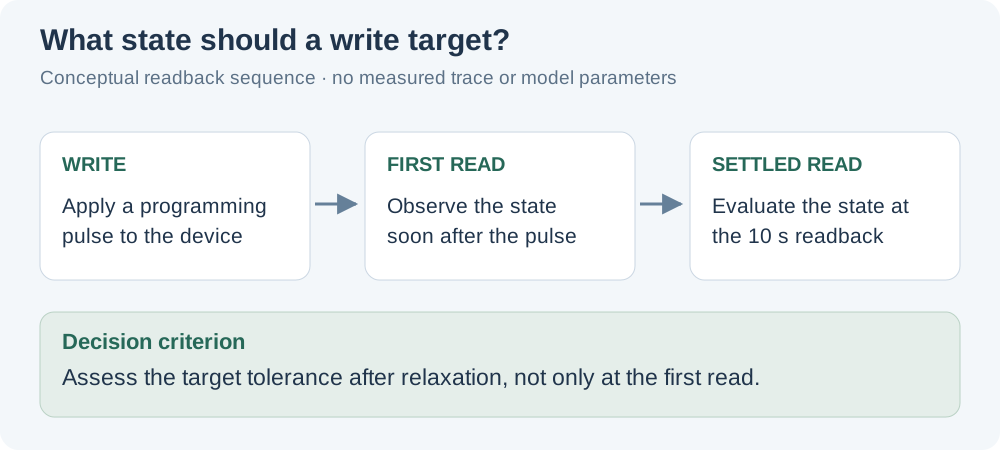
How can a programming strategy reach a useful conductance state when a memristor continues to relax after a write?
In Au–CeO₂ vertically aligned nanocomposite (VAN) devices, gradual conductance tuning provides a route to multilevel operation. A state observed immediately after a pulse can differ from the state available later. My work connects device characterization, compact modeling, and experimental programming evaluation around that distinction.

My contribution
I developed a measurement-calibrated behavioral compact model and experimentally evaluated model-informed programming. This builds on my work in VAN RRAM fabrication, electrical characterization, and automated analysis in Wang’s Thin Film Group.
- Device characterization. I examined switching behavior and post-write stability, connecting electrical observations to the practical demands of multilevel operation.
- Model development. I translated measured nonideal behavior into a simulation model and assessed its predictive accuracy against device measurements.
- Experimental evaluation. I compared programming outcomes using a defined readback time and conductance tolerance, while also tracking programming effort.
The engineering challenge is to make prediction accuracy useful in a physical programming experiment. A low model error and a high targeting success rate answer different questions, so both are reported below.
Results & experimental scope
The following summary matches the results reported in my CV.
| Evaluation | Reported result | What it establishes |
|---|---|---|
| Settled-state prediction | 0.042-decade mean absolute error at 10 s | Predictive agreement for the evaluated measurements |
| Conductance targeting | 22% → 94% within ±0.05 decade | Improvement in the reported single-cell programming comparison |
| Programming effort | Mean pulse count 3.3 → 2.7 | Fewer pulses in that comparison |
These results describe a bounded experimental evaluation, not an array-wide yield or reliability specification. Validation across additional devices and conditions remains important. The combination of prediction error, targeting success, and pulse count makes the benefit and its scope explicit.
Related research
Related manuscript: Henan Wang, et al., “A CeO₂:Au Vertically Aligned Nanocomposite Memristor: From Nonideal Switching Dynamics to Model-Informed Conductance Multilevel Programming.” Manuscript completed; planned for submission to IEEE EDTM 2027.